
At Compass Counselling, we explore wellbeing from a holistic perspective, recognising that people experience themselves not only through their thoughts and emotions, but also through their bodies, intuition, creativity, relationships and sense of connection.
Previous Compass Counselling blogs and resources have explored topics such as mindfulness, meditation, grounding, chakras, energy psychology, Emotion Code and Body Code, self-compassion, nervous system regulation and raising your vibration. Another fascinating area that can sit alongside these conversations about awareness and intuition is remote viewing.
Remote viewing has an unusual history. It has been investigated by researchers and intelligence agencies.
What Is Remote Viewing?
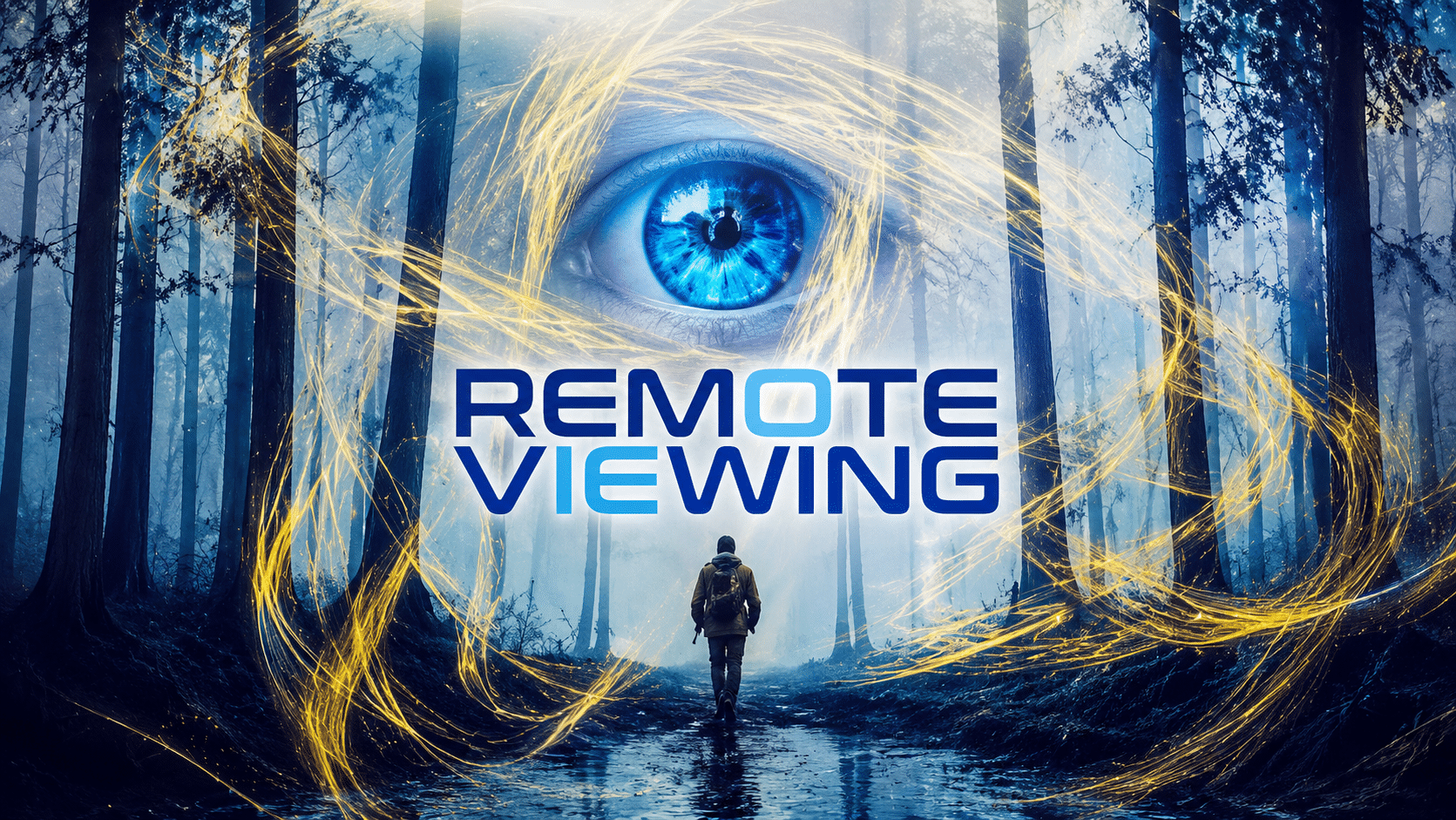
Remote viewing generally refers to a structured practice in which a person attempts to describe information about a location, object, event or “target” that is not available to them through their ordinary senses.
The term became particularly associated with research undertaken in the United States during the 1970s and subsequent government-funded investigations into whether anomalous perception might have practical applications.
A remote viewer may be given very little information about a target—sometimes only a number or other identifier—and then record impressions that arise. These might include:
- shapes, colours and textures
- temperature or environmental impressions
- movement or spatial relationships
- sounds or sensory impressions
- sketches and images
- emotional or intuitive impressions
- words, concepts or spontaneous associations.
One important aspect of structured remote viewing is attempting to record impressions without immediately analysing or interpreting them.
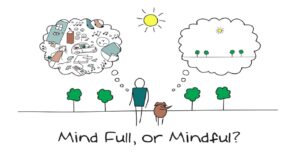
This creates an interesting parallel with mindfulness: notice first, interpret later.
A Brief History of Remote Viewing
Although people have described intuitive, clairvoyant and anomalous experiences throughout history, the modern term remote viewing is most closely associated with research conducted at Stanford Research Institute in California during the 1970s.
Researchers including physicists Harold Puthoff and Russell Targ investigated reports of anomalous perception, including work involving individuals such as Ingo Swann. Their experiments explored whether people could obtain information about distant or unseen targets without using conventional sensory information.
The research eventually attracted interest and funding from various United States government and intelligence organisations.
Over approximately two decades, different programs investigated whether remote viewing could have intelligence-gathering applications. These efforts eventually became popularly associated with the Stargate Project. In 1995, the government program was discontinued.
Remote Viewing, Intuition and Self-Awareness
For clients interested in holistic wellbeing, perhaps one of the most useful ways of approaching remote viewing is as an exercise in observation, intuition and awareness.
We receive enormous amounts of information throughout the day. Some of it reaches conscious awareness, while much of it is processed outside our immediate conscious attention. Learning to slow down and notice subtle impressions can encourage a different relationship with our internal experience. Instead of immediately asking:
- Is this right or wrong?
- we might first ask:
- What am I noticing?
That distinction connects remote-viewing exercises with several practices already explored through Compass Counselling.
Remote Viewing and Mindfulness
Mindfulness involves intentionally bringing attention to present-moment experience with openness and reduced judgement. Remote viewing can involve a similar observational stance. A person may notice an image, sensation, colour or thought and practise recording it without immediately constructing a story around it. For example, rather than deciding:
- “I can see a lighthouse beside the ocean,”
- a person might initially record:
- “Tall structure. Bright area at the top. Open space. Cool. Movement. Blue or grey.”
This process can encourage us to distinguish between raw experience and interpretation. That skill can also be valuable in everyday emotional wellbeing. When experiencing anxiety, for example, we can learn to notice:
- My chest feels tight. My breathing has changed. I am having a thought that something will go wrong.
- This is different from automatically concluding:
- Something bad is going to happen.
Mindfulness, grounding and nervous-system regulation can help us create that small but important space between experience and interpretation.
Remote Viewing and Meditation
Meditation may also complement remote-viewing practice. When our minds are busy, it can be difficult to distinguish subtle impressions from expectations, worries, memories and mental chatter. A short period of breathing or meditation before an intuitive exercise may help a person settle their attention. Meditation can improve awareness of internal experience and may make it easier to observe thoughts and sensations without immediately reacting to them.
The breathing, mindfulness and meditation practices explored in other Compass Counselling resources can therefore provide a useful foundation for anyone interested in exploring intuitive awareness.
Grounding Before Exploring Intuition
Grounding is particularly important when working with intuitive or energy-based practices. Before beginning, you might take a few moments to:
- feel your feet connecting with the floor,
- notice the support of the chair beneath you,
- slow your breathing,
- observe five things around you,
- or spend a few minutes connecting with nature.
Grounding reminds us that exploring intuition does not require disconnecting from our physical environment. Ideally, it involves becoming more present, not less. This also connects with our previous discussions about nervous-system regulation and vagus nerve calming.
Remote Viewing and the Subtle Energy Perspective
People who work within spiritual or energy-based frameworks may interpret remote viewing differently. Some associate intuitive perception with concepts such as the third-eye chakra, subtle energy, expanded consciousness or interconnectedness. Within chakra traditions, the third-eye chakra—or Ajna—is commonly associated with intuition, insight and inner perception. Practices such as meditation, visualisation and energy work are sometimes used to explore this aspect of awareness.
From a holistic perspective, a person might therefore choose to explore remote viewing alongside chakra work, aura clearing, meditation or other intuitive practices.
How Could Exploring Remote Viewing Help Clients?
Remote viewing exercises may provide some clients with an interesting way to explore aspects of themselves. It may encourage:
Mindful observation
Learning to notice impressions before judging or analysing them.
Trust in yourself
Some people constantly second-guess themselves. Structured intuitive exercises may provide a playful environment for noticing what arises without demanding perfection.
Awareness of assumptions
Remote-viewing practice often highlights how quickly the mind tries to turn limited information into a complete story. Recognising this tendency can be useful far beyond remote viewing.
Creativity and imagination
Sketching, visualisation, sensory awareness and free association can activate creative ways of engaging with experience.
Body awareness
Some people notice intuitive impressions through physical sensations. Exploring these carefully may encourage greater awareness of bodily signals.
Tolerance of uncertainty
A remote-viewing exercise involves not knowing the answer. Learning to remain curious without immediately resolving uncertainty can itself be a valuable psychological skill.
Reflective practice
Journalling about what was noticed, what was assumed and what happened when the target was revealed can encourage self-reflection.
Remote Viewing, Self-Compassion and Letting Go of Being “Right”
Compass Counselling’s recent discussion of self-compassion and grace is also relevant. If someone approaches remote viewing believing they must get everything correct, the activity can quickly become another exercise in self-criticism. Instead, it can be approached with curiosity:
- What did I notice?
- What did I assume?
- Where did my mind fill in the gaps?
- What surprised me?
- What can I learn about how I process information?
There does not need to be failure, there can simply be observation. This is very similar to mindfulness and self-compassion: noticing our experience without constantly judging ourselves for having it.
Bringing the Pieces Together
Remote viewing sits at an interesting intersection between psychology, consciousness research, intuition, meditation, creativity and spirituality. For some people, remote viewing will be fascinating because of the possibility of anomalous perception. Others may remain sceptical but find the exercises themselves interesting as a way of exploring attention, assumptions, sensory imagery and uncertainty.
At Compass Counselling, holistic wellbeing does not have to mean accepting every idea without question. It can mean remaining curious about our experiences while staying grounded, reflective and compassionate. Remote viewing can therefore be considered alongside many of the themes we have previously explored—mindfulness, meditation, grounding, chakra awareness, nervous-system regulation, self-compassion, and intuitive practices.
A valuable question is: “What happens when I quieten the noise, become present and genuinely pay attention to what I notice?”
Want to Explore Your Intuitive Awareness?
If topics such as mindfulness, meditation, grounding, chakra and aura work, emotional clearing, self-compassion or intuitive awareness resonate with you, Compass Counselling offers a holistic space in which you can explore the connection between mind, body and your personal sense of meaning and spirituality.
You can also explore our previous blogs and free workbooks on mindfulness, meditation, grounding, boundaries, self-compassion, gratitude, breathwork, raising your vibration, chakras, Emotion Code and Body Code to continue building your personal wellbeing toolkit.
Final Thoughts and Workshop
If you’d like to explore this further, you can book a session or look through our growing library of free resources for additional support. Please contact Michele to find out more about our services: Contact Us – Compass Counselling. If you’d like personalised support for improving your sleep, stress, or emotional wellbeing, reach out to book a free 30-minute breakthrough call at
👉 www.compasscounselling.com.au
Michele has been studying Remote Viewing with Dr Irina Webster for the last 12 months and will be having an introductory workshop using Remote Viewing – Focusing on your Future Self on 12 September 2026, limited spots available, if you are interested, please book in:
👉 Tickets for Spirit Trails & Compass Counselling Springtime Mini Workshops
Sending you all love and light,
Michele Chaseling
References and Further Reading
American Institutes for Research. (1995). An evaluation of remote viewing: Research and applications. Prepared for the Central Intelligence Agency.
Cardeña, E. (2018). The experimental evidence for parapsychological phenomena: A review. American Psychologist, 73(5), 663–677.
Central Intelligence Agency. (n.d.). Stargate Collection. CIA Freedom of Information Act Electronic Reading Room.
Hyman, R. (1995). Evaluation of program on anomalous mental phenomena. American Institutes for Research.
Mossbridge, J., & Radin, D. (2018). Precognition as a form of prospection: A review of the evidence. Psychology of Consciousness: Theory, Research, and Practice, 5(1), 78–93.
Puthoff, H. E., & Targ, R. (1976). A perceptual channel for information transfer over kilometer distances: Historical perspective and recent research. Proceedings of the IEEE, 64(3), 329–354.
Targ, R. (2012). The reality of ESP: A physicist’s proof of psychic abilities. Quest Books.
Utts, J. (1995). An assessment of the evidence for psychic functioning. American Institutes for Research.
Webster, I. (2025). Remote Viewing. Bridging Science, Intuition, and Healing. Inspiring Publishers.