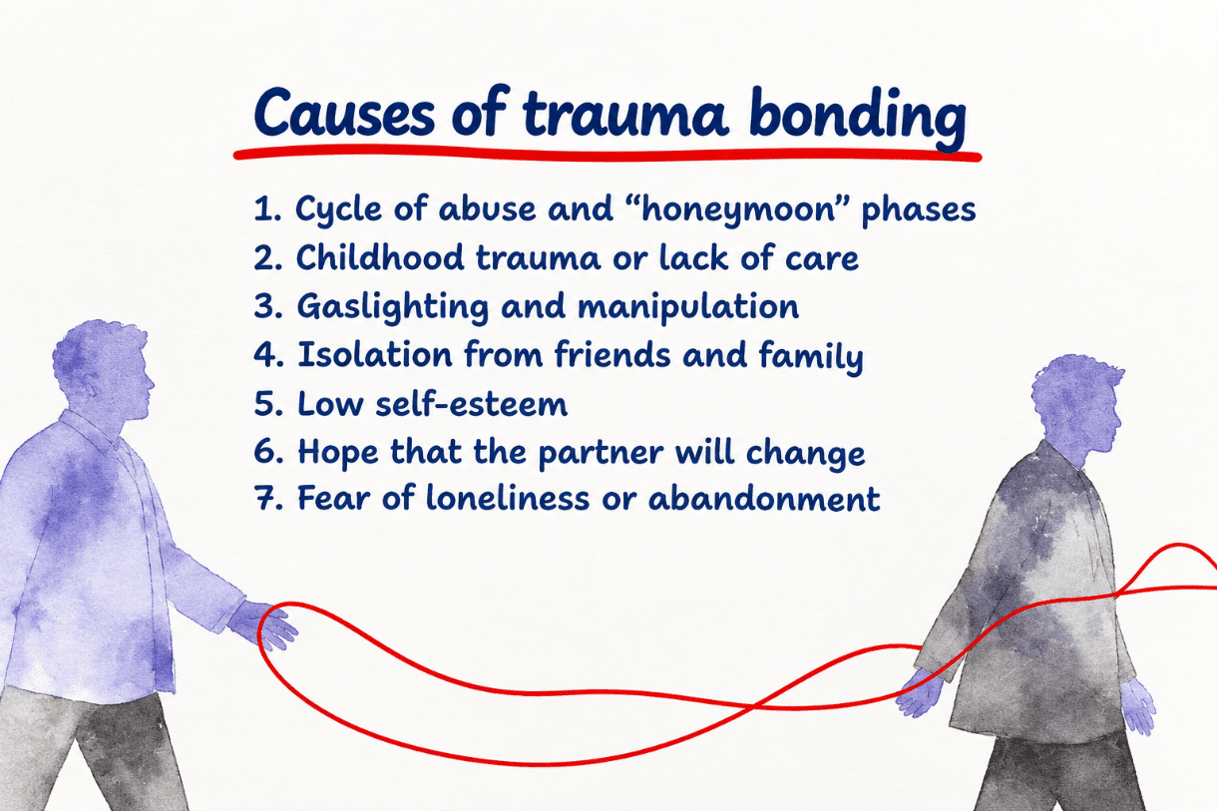

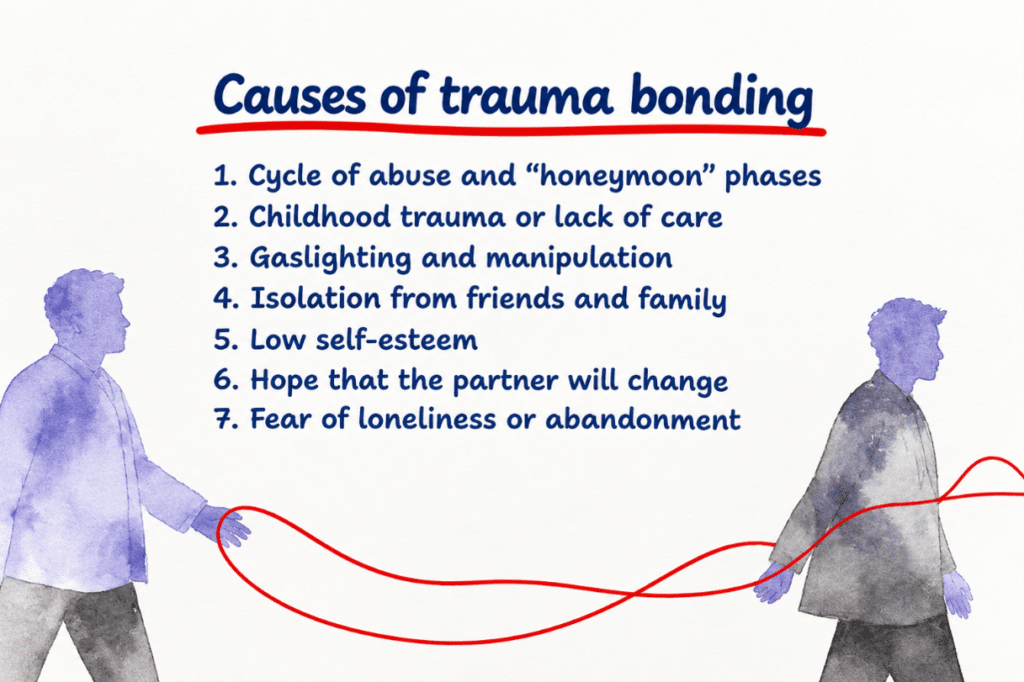
People looking from the outside of an unhealthy or abusive relationship may sometimes ask: “Why don’t they just leave?” For the person experiencing the relationship, however, the situation can be far more complicated. They may recognise that the relationship is hurting them while simultaneously feeling intensely attached to the person causing the harm. They may leave and return, continue hoping the relationship will change, defend their partner’s behaviour, or feel an overwhelming pull towards them even after the relationship has ended. One concept that can help us understand this experience is trauma bonding. Understanding trauma bonding can help shift the question away from: “Why did you stay?” towards a more compassionate and useful question: “What happened within this relationship that made leaving — and staying away — so difficult?”
What is trauma bonding?
Trauma bonding describes a strong emotional attachment that can develop within a relationship involving abuse, coercion or a significant imbalance of power. The concept of traumatic bonding has been studied for decades. Research by Dutton and Painter examined strong emotional attachments among women who had recently left abusive relationships and considered the roles of power imbalance and intermittent abuse in maintaining these attachments. Trauma bonding should not be confused with two people becoming close because they have both experienced trauma. Instead, it refers to an attachment that develops or becomes strengthened within a harmful or abusive relationship.
This means that someone can intellectually recognise: “This relationship is hurting me.” while another part of them continues to feel: “But I love them. I miss them. I need them. Maybe things will change.” Both experiences can exist at the same time. The cycle of hurt and connection Abusive relationships are not necessarily abusive every minute of every day. There may be periods of affection, attention, intimacy, apologies, promises and apparent change interspersed with periods of criticism, manipulation, withdrawal, intimidation, coercive control or violence. This unpredictability can become psychologically powerful.
Following a distressing incident, the other person might apologise: “I’ll never do it again.” “I don’t know what came over me.” “You’re the only person I need.” “Things will be different from now on.” When affection and reassurance return after fear, conflict or rejection, the resulting relief and reconnection can feel extremely intense. The person may begin waiting for the loving version of their partner to return. Patterns of power imbalance and intermittent mistreatment followed by positive experiences are among the mechanisms described in traumatic-bonding theory.
Trauma bonding and coercive control
Trauma bonding may also occur within a broader pattern of coercive control. Coercive control involves repeated patterns of behaviour used to dominate, frighten, isolate or reduce another person’s independence. It can include controlling finances, monitoring communications or movements, isolating someone from family and friends, humiliation, threats and creating rules or consequences for not complying.
Sometimes controlling behaviour may initially be disguised as love or concern. Over time, a person may begin doubting their perceptions and judgement. They may become increasingly isolated. They may feel responsible for keeping the other person calm. They may become afraid of saying or doing the wrong thing. They may believe they cannot cope without the relationship. Or they may fear what will happen if they leave. This is one reason why simply telling someone to “walk away” can fail to recognise the psychological, emotional, financial, practical and sometimes physical barriers they may be experiencing.
Signs you may be experiencing a trauma bond
Everyone’s experience is different, and experiencing one or two of these things does not necessarily mean someone has developed a trauma bond. However, a person may notice that they:
- know the relationship is harmful but feel unable to let go;
- repeatedly leave and return;
- focus strongly on the person’s good qualities while minimising harmful behaviour;
- continue hoping the person will return to how they were at the beginning;
- feel responsible for the person’s behaviour or emotions;
- make excuses for behaviour they would consider unacceptable in somebody else’s relationship;
- experience intense relief when conflict ends and affection returns;
- feel guilt or anxiety when creating distance;
- feel compelled to respond when the person contacts them;
- struggle to maintain boundaries;
- question whether events really happened the way they remember them;
- have difficulty trusting their own judgement;
- feel that nobody else understands the relationship; or
- continue craving contact even after the relationship has ended. Trauma bonding is a useful concept for understanding certain relationship dynamics, but it should not be used to label every difficult relationship or explain every reason someone remains with an abusive partner. “But there were good times too”.
One of the most confusing aspects of an abusive relationship can be that the positive experiences may have been real. There may have been love. There may have been laughter. There may have been affection, intimacy, holidays and wonderful memories. There may have been plans for a shared future. The person who caused harm may also have vulnerabilities and positive qualities or periods when they behave very differently. Recognising those experiences does not mean that abuse did not occur. Two realities can exist together: “I loved this person.” and “This relationship harmed me.” Healing does not require someone to pretend that every moment of their relationship was terrible. Instead, it can involve gradually developing the ability to see the whole relationship, rather than judging it only by its best moments.
Why can it be so difficult to recognise what is happening?
Coercive control can develop gradually. Behaviour that might have seemed unacceptable at the beginning of a relationship can slowly become normalised. There may also be gaslighting — manipulative behaviour that can cause someone to question their memories, perceptions or understanding of events. Australian family-violence information describes coercive control as a persistent pattern of controlling behaviour that can be subtle and difficult to recognise, particularly when individual behaviours are considered in isolation. Isolation can make this even more powerful. When someone’s relationships with friends, family and community have gradually diminished, the abusive partner can become both the source of distress and one of the person’s main sources of connection.
Trauma, stress and the nervous system
Living with unpredictability, fear or ongoing emotional threat can place significant demands on the body’s stress-response systems. Some people may experience periods of hyperarousal, including feeling constantly alert, anxious, restless or unable to relax. Others may experience exhaustion, emotional numbness or shutdown. People may also experience difficulties with sleep, concentration and emotional regulation.
Research examining coercive control has found associations with PTSD and depression, reinforcing the importance of trauma-informed support for people who have experienced these relationships. This can help us understand why recovering from an abusive relationship can involve much more than simply deciding not to contact someone again. The mind and body may both need time to adjust to greater safety, predictability and independence.
Why leaving can feel worse before it feels better
Ending the relationship does not necessarily end the emotional attachment. A person may experience grief, loneliness, anxiety, confusion and powerful urges to reconnect. They may remember the good times and question whether what happened was really “that bad.” They might think: “Maybe I overreacted.” “Maybe they’ve really changed this time.” “Maybe I should just speak to them once.”
Missing somebody does not mean that returning to the relationship is necessarily safe or healthy. An important part of recovery can be learning that: You can miss someone and still recognise that contact with them may be harmful to you.
Beginning to break a trauma bond
There is no single formula for breaking a trauma bond, particularly where domestic or family violence is involved. Safety should always be considered, as separation can sometimes be a period of increased risk. Recovery may involve gradually rebuilding things that were weakened during the relationship, including: Safety. Identity. Connection. Boundaries. Confidence. Choice. Self-trust.
It may help to begin recognising patterns rather than looking only at individual incidents. Keeping a private record of events may help some people hold onto their own understanding of what happened, provided doing so is safe. Other helpful steps can include reconnecting with trusted people, learning about coercive control, establishing boundaries, rebuilding routines and interests, and seeking trauma-informed professional support.
It can also be useful to change the questions you ask yourself. Instead of: “Why do I still love them?” consider: “What happens to me when I’m in this relationship?” Instead of: “Do they love me?” consider: “Do I feel safe, respected and free to be myself?” These questions begin bringing the focus away from understanding or changing the other person and back towards you.
Self-compassion and recovery
People who have experienced abusive relationships can carry significant shame. They may criticise themselves for staying. For going back. For believing promises. For ignoring warning signs. Or even for continuing to miss the person after leaving. Self-compassion offers a different response: “I made decisions within circumstances that were much more complicated than they may appear from the outside.”
Recovery can involve learning to trust your perceptions again, listening to your body, recognising your needs, establishing boundaries and gradually reclaiming choice. This is also where self-compassion and grace can become important. You cannot change what happened. But you can begin changing the way you treat yourself because of what happened.
Reconnecting with yourself
An abusive or controlling relationship can gradually make someone’s life revolve around another person. What mood are they in? What will upset them? Should I say this? How can I keep the peace? What do they want me to do?
Recovery involves gradually turning some of that attention back towards yourself. What do I feel? What do I need? What matters to me? What does my body tell me? Which relationships make me feel safe and respected? What do I want my future to look like? The process can take time. But every small decision that belongs to you can be part of rebuilding autonomy and self-trust.
NSW Victims Services – You May Be Eligible for Free Counselling
If you have experienced domestic or family violence in NSW, you may be eligible for counselling through the NSW Victims Support Scheme. The scheme provides support to eligible victims of acts of violence occurring in NSW. Victims Services assesses each application and determines eligibility. Eligible people may receive up to 22 hours of counselling, with additional counselling potentially available in some circumstances. Importantly, accessing support does not necessarily depend upon the offender having been charged or convicted, although Victims Services requires information or evidence supporting the application. You can find information about applying through NSW Victims Services or contact the Victims Access Line on 1800 633 063.
Counselling with Michele through Victims Services
Michele from Compass Counselling is an approved counsellor with NSW Victims Services. If you are approved for counselling and Michele is available to accept your referral, you can request counselling with her.
Sessions can be provided online or face to face, allowing you to access support even if you do not live near the Compass Counselling practice. NSW Victims Services permits approved counselling to be provided in person, by telephone or online. Michele can provide trauma-informed counselling around experiences including domestic and family violence, coercive control, trauma bonding, grief and loss, anxiety and hypervigilance, rebuilding boundaries, loss of confidence and difficulties trusting your own judgement.
How Compass Counselling can support you
At Compass Counselling, we understand that leaving an unhealthy or abusive relationship does not necessarily mean that its emotional effects immediately disappear. Trauma-informed counselling can provide a non-judgemental space to understand what happened, recognise patterns such as trauma bonding and coercive control, rebuild boundaries and self-trust, and begin reconnecting with your own needs and identity. Where appropriate and chosen by the client, counselling may also be supported by practices such as mindfulness, grounding, breathwork, self-compassion and other holistic wellbeing resources. Recovery is about more than leaving the relationship. It can also be about reclaiming yourself.
With appropriate support, you can begin to understand what happened, reconnect with yourself and your body, reclaim your power and freedom, and feel more in control of your life and future. That journey does not have to happen all at once. Sometimes reclaiming your life begins with one small decision: “Today, I am going to listen to myself.”
If you are currently unsafe
If you are currently experiencing domestic or family violence, specialist safety planning and support may be important. In Australia, 1800RESPECT provides free, confidential domestic, family and sexual violence support. You can call 1800 737 732 or text 0458 737 732. If you or someone else is in immediate danger, call 000.
References
- Dutton, D. G., & Painter, S. (1993). Emotional attachments in abusive relationships: A test of traumatic bonding theory. Violence and Victims, 8(2), 105–120.
- Dutton, D. G., & Painter, S. (1993). The battered woman syndrome: Effects of severity and intermittency of abuse. American Journal of Orthopsychiatry, 63(4), 614–622.
- Lohmann, S., Cowlishaw, S., Ney, L., O’Donnell, M., & Felmingham, K. (2024). The trauma and mental health impacts of coercive control: A systematic review and meta-analysis. Trauma, Violence, & Abuse, 25(1), 630–647.
- NSW Department of Communities and Justice, Victims Services. (n.d.). Victims Support Scheme: Eligibility criteria and counselling. NSW Government.
- Reid, J. A. (2024). Trauma bonding and intimate partner violence. In Trauma Bonding and Interpersonal Crimes. Wiley.
- Wong, I., & Denson, T. F. (2025). Understanding the mechanisms underlying the association between insecure attachment and intimate partner violence: Meta-analyses and a systematic review of mediators. Clinical Psychology Review, 121, 102645.